
Speak Your Hair's Language: A Glossary of Scalp and Hair Terms You're Probably Getting Wrong
Smooth, silky, volume, bounce, oily, dry, frizz; we all throw these words around. Stylists say them, influencers say them, your aunt says them, and you say them back to your stylist hoping you're describing the same thing. But here's the catch: most of these terms get used interchangeably when they actually mean very different things. And when you don't know the difference, you end up treating the wrong problem: chasing "volume" when you mean "density," or fighting "greasiness" that's really just build-up.
Understanding what these words actually mean is the first real step to diagnosing your own hair and scalp correctly. So let's break down the vocabulary of the hair world—and clear up the pairs that trip everyone up.
Scalp Terms
Your scalp is where most hair problems begin, and it's also where the most confusion lives. Several of these terms feel like synonyms but describe completely different conditions.
Oily: This is simply the natural oil your scalp produces on its own cycle after a wash. It's your body doing its job. Crucially, this is not the same as greasy—oily is what your scalp makes internally, without anything external mixed in.
Greasy: This is what happens when those natural oils collect alongside sweat, pollution, dirt, and small flakes. The scalp starts to feel heavy, sticky, and weighed down. So while oily is purely internal, greasy is the result of external factors piling onto that oil over time.
Sensitive: A sensitive scalp is one that gets inflamed. You might notice pink or reddish bumps, or feel pain and a pulling sensation right at the follicles. These are all signs that your scalp is reacting and irritated at a deeper level.
Itchy: Itchiness is the irritation and the urge to scratch. It can come from dryness, from inflammation, or from other underlying medical issues at the scalp. On its own, it's a symptom rather than a diagnosis—it points you toward a cause you still need to identify.
Flaky: Flaking is dry skin that physically separates from the scalp but stays sitting on it. Flakes can range from tiny white specks all the way to chunky pieces around a centimetre in size.
Dry: A dry scalp feels dehydrated, tight, and like there's a constant pull or tension across the surface. This happens when the scalp lacks the natural oils it needs to stay comfortable and supple.
Dandruff: This one is often misused as a catch-all, but dandruff is specifically a bacterial infection of the scalp. It brings dryness, flaking, itching, and sensitivity together, and the clearest tell is the itching. Here's how to distinguish it from ordinary flaking: dandruff shows up in "patches" or cultures, wherever the bacteria has settled, whereas plain flaking spreads more evenly across a whole area of the scalp.
Deposit vs. Build-Up
These two get confused constantly, and the difference comes down to where the gunk comes from.
Deposit: This is the oily, greasy, flaky, or pasty residue that appears on your scalp because of the products you're using—either the products themselves sitting on the skin, or your scalp reacting to them. It's entirely about what you're applying externally.
Build-Up: This looks similar—flaky, greasy, pasty residue—but it comes from stretching out your wash days. Both natural oils and environmental factors accumulate over time, quite literally "building up" between washes. So if you've been going longer between washes, you're looking at build-up. If you've recently changed or piled on products, you're looking at deposit.
Hair Terms
Once we move from the scalp to the strands themselves, the vocabulary gets even more tangled—especially the trio of volume, density, and thickness, which people use as if they're the same thing. They aren't.
Volume: Volume is purely about appearance—how your hair is falling and sitting. It runs on a scale from flat and limp on one end to voluminous, big, and bushy on the other. Importantly, volume is not density. You can have plenty of hair that sits flat, or less hair that looks big.
Density: Density is the actual number of hair strands you have on your head. It's classified as low, medium, or high depending on how much hair is physically there. This is a count, not a look.
Thickness: Thickness refers to the diameter of an individual strand—its cross-section size. A strand can be thick, medium, or thin. So density is how many strands you have, while thickness is how wide each one is. You can have high density with thin strands, or low density with thick ones.
Porosity: This is your hair's ability to absorb and hold water, and it can be high, medium, or low. It behaves in a way that feels counterintuitive at first: high porosity hair actually rejects water, while low porosity hair absorbs it and stays wet.
Elasticity: Elasticity is your strand's ability to stretch and then return to its original structure. High elasticity hair springs back well after being stretched; low elasticity hair snaps instead of recovering.
Texture: Texture is about the outermost layer of the strand and how well the hair holds and sits, both on its own and with products. Coarse hair has rough-feeling strands that grip and stay put. Medium texture is smooth with slight, even irregularities and holds for a reasonable duration. Smooth texture means completely smooth strands that don't hold anything or stay in place.
Pattern: Pattern is the shape your strands form, determined by their bond structure and elasticity. You'll hear the common words—straight, wavy, curly, kinky—but technically we sort these into the numbering system (2B, 3A, 4C, and so on).
Shrinkage: Shrinkage is the amount your hair draws up and shortens when it's well moisturised. Healthy, hydrated hair pulling upward is a good sign, even if it makes your hair look shorter than it really is.
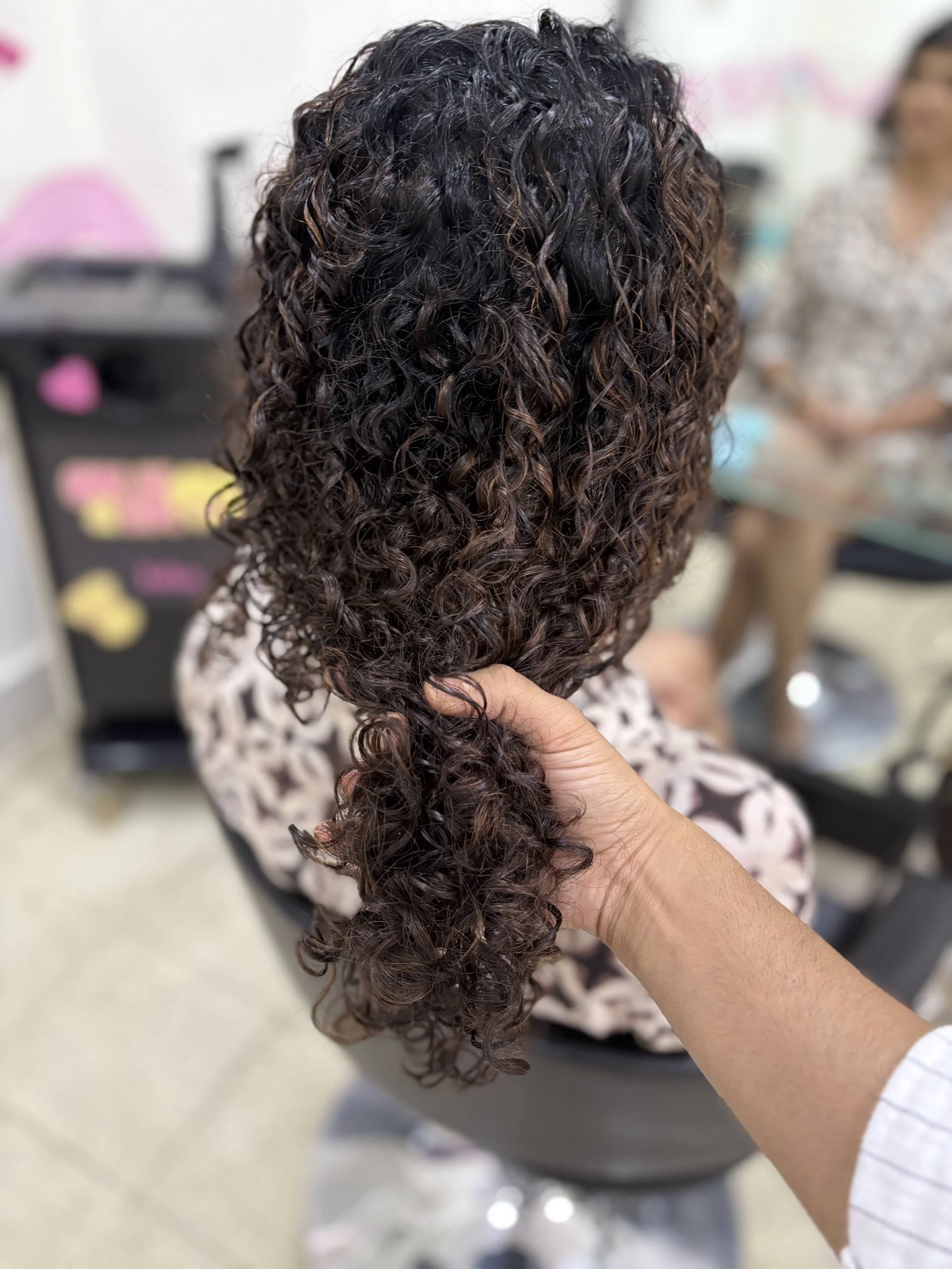
Clumps: Clumps are the bunches that form when moisture returns and gets absorbed within and between your strands. Curly, wavy, and kinky hair types form clumps when they're properly moisturised and healthy—so clumping is something to celebrate, not fight.
The Two Overdoses
Just as hair can be starved of what it needs, it can also be overloaded. These two conditions look like problems you'd want to fix with more care, when the real fix is easing off.
Moisture Overdose: This is when your strands absorb too much moisture and become overly soft and smooth. The result is hair that stretches out and goes flat, because it's taken on more water than it can structurally handle.
Protein Overdose: This is the opposite imbalance. When hair over-absorbs protein it doesn't actually need, the outer surface becomes uneven and the strand grows heavier and structurally compromised. The hair ends up limp and weak—not because it's lacking something, but because it's been given too much.
Why This Vocabulary Matters
None of this is about sounding technical for its own sake. When you can tell the difference between oily and greasy, you know whether to change your products or just wash out the day's grime. When you understand that volume isn't density, you stop chasing a look your hair count can't give you and start working with what you have. And when you recognise the two overdoses, you know when to back off instead of piling on more.
Getting the words right is how you stop guessing and start actually diagnosing your hair. The next time you talk to your stylist—or reach for a product—you'll know exactly what you're describing, and exactly what your hair is asking for.
