
Hair Care for Indian Curly Hair: Why Your Routine Needs to Be Built for You, Not Borrowed From Someone Else
If you've ever tried to follow a curly hair routine you found online and wondered why it just didn't work the same way it seemed to for everyone else, you're not doing anything wrong. Most curly hair content out there, the products, the routines, the "10 steps to perfect curls" reels, is built around a specific set of hair textures and climates that often aren't Indian hair, and aren't Indian weather either.
Indian curly hair deserves its own conversation, not a borrowed one. So let's have it.
Indian Curly Hair Is Its Own Category, Not a Subcategory
Indian curls tend to run the full spectrum, from loose waves to tight coils, often within the same family, sometimes even on the same head. What's common across most Indian curl patterns, though, has a tendency to get dry at the ends, a drier scalp than a lot of international routines account for, and hair that's spent years being chemically treated, heat styled, or oiled heavily using methods passed down rather than tested against curl-specific needs.
None of that is a flaw to fix. It's just the actual starting point, and any routine that ignores it is going to leave you working against your own hair instead of with it.
Start With Water Retention, Not Product Shopping
We say this to every curly client who walks in, and it holds true here too: <a href="https://www.curlupanddye.in/blog/foundational-focus-prioritizing-your-curly-hair-journey">the foundation of every good hair routine is water retention</a>, not the number of products on your shelf. For Indian curls specifically, this usually means a proper conditioning and moisturising rhythm that fits your climate, because a routine built for cooler, drier countries simply won't hold up through an Indian summer or monsoon season the same way.
Get the moisture foundation right first. Definition, frizz control, and longer-lasting styles all follow from that, not from adding more products on top of dry hair.
Respect the Oil Habit, But Rethink the Application
Oiling is one of the most inherited parts of Indian hair care, and there's real value in it, particularly for scalp health. Where it tends to go wrong is in application, timing and amount: heavy oil left on for days, or applied right before a wash without enough clarifying afterward, can leavescalp sticky and form layers that dont allow the skin to breathe
A lighter hand, a clarifying wash when needed, and oilingonly the scalp specifically rather than drenching the lengths tends to work far better for most Indian curl patterns than the "more oil, more often" approach many of us grew up with.
Humidity Isn't the Enemy, Under-Moisturised Hair Is
A lot of Indian curlies blame humidity for frizz, and while humidity is a factor, well-hydrated curls handle humidity far better than dry ones do. Frizz is usually a sign that your hair is reaching for moisture from the air because it isn't getting enough from your routine. Fix the moisture foundation, and humidity stops being the villain it's made out to be.
Choosing Products That Actually Suit Indian Hair and Climate
Not every internationally popular curl product is built for Indian conditions. Heavier butters and creams that work beautifully in drier, cooler climates can feel greasy and heavy within hours in Indian humidity. Look for lighter gels and creams that still offer hold and definition without weighing hair down, and don't be afraid to mix textures across seasons, lighter in summer and monsoon, slightly richer in winter.
Cuts and Colour Matter Just as Much as Products
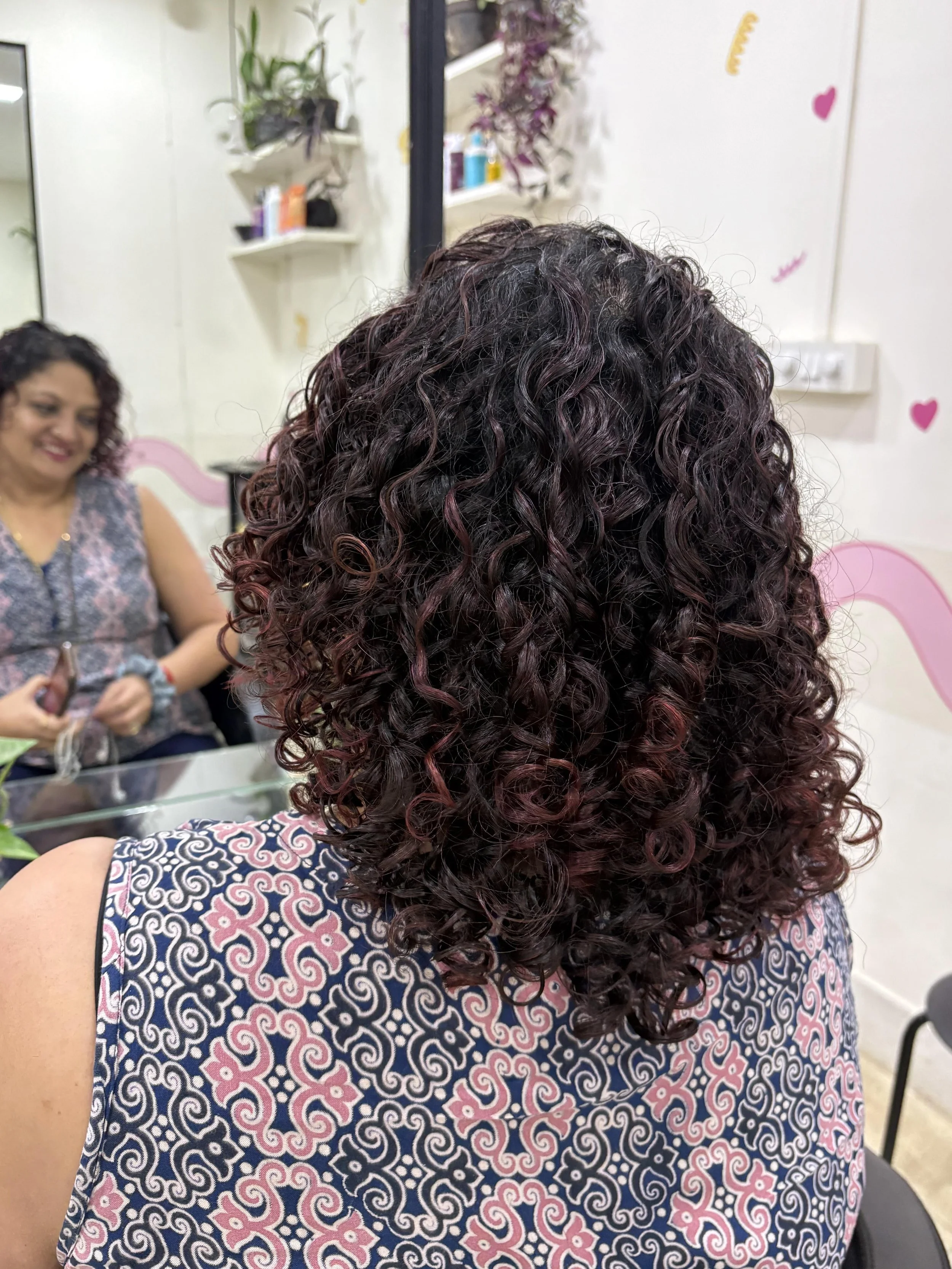
Hair care for Indian curly hair isn't only about what you put on your strands. The cut itself needs to work with your specific curl pattern and density, not against it, and any colour or chemical service needs a stylist who understands how it will interact with your natural texture rather than flattening it. This is really where a lot of Indian curlies get let down, not by their routine at home, but by a haircut that was never designed around their curl pattern to begin with.
What We'd Actually Recommend in the Chair
If you came in for a consult, this is genuinely where we'd start: understanding your specific strand thickness, density and porosity, your scalp type, talking through your climate and how often you wash, and building a routine from there, rather than handing you a generic list. No unnecessary selling, no products for the sake of it. Just what your hair, in your city, in your weather, actually needs.
The Takeaway
Indian curly hair doesn't need a workaround, it needs a routine that was actually built for it. Start with moisture, respect your scalp's habits without overdoing them, choose products suited to Indian climate rather than someone else's, and get a cut that works with your curl pattern instead of against it. That's the whole secret, really, and it's simpler than most routines make it look.
